
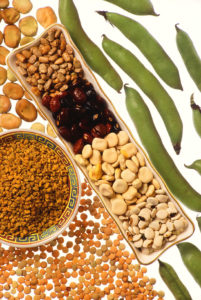
For many years we’ve been told to “eat your vegetables” but Mom never told us to “eat your pulses.” The FDA is now studying whether there may be a connection between pulses or potatoes in pet food and some medical issues.
Pulses are the seeds of certain legumes like beans, peas and lentils. They are often considered vegetables, although by definition fall into a category of their own. Pulses are high in both protein and fiber, and can be used as a meat substitute to supply protein. So why would the FDA be concerned about pulses in pet food?
Last month the FDA announced they were looking at a potential link between diet and canine heart disease
Recent reports to the FDA have raised concerns that potatoes or pulses as primary ingredients in pet food may contribute to higher than normal levels of canine dilated cardiomyopathy (DCM). DCM is a heart disease which can result in congestive heart failure.
The primary causes of DCM is unknown but has often been linked to genetics. Large and giant breed dogs have been most susceptible to DCM, and it is much less common in small and medium breeds with a few exceptions. The cases recently reported to the FDA have included Goldens, Labs, Whippets, a Shih Tzu, a Bulldog and Miniature Schnauzers, as well as mixed breeds.
Which brings us to the validity of the claims on both sides
Most but not all foods which use potatoes and pulses among the first few ingredients are grain-free formulas. A quick glance at your Ingredient List will show whether your grain-free food shares characteristics of the category being investigated. Do you see potatoes or pulses listed in among the first 3 or 4 ingredients? If so, your food may be under investigation.
There has been pushback from the pet food industry which regards the FDA’s announcement and investigation as premature. After reviewing the FDA documentation, it appears clear to us that the announcement is making no claims. Rather, it is issuing an alert that the investigation into a possible connection between these ingredients and DCM exists.
Rather than look at this as an unnecessary scare tactic, it appears to be a cautious sharing of facts which warrant further investigation.
Is ignorance bliss?

Some would argue that a blanket warning against the use of all grain-free foods is an overreach. We would tend to agree if that was the position being put forth, but it is not.
No warnings or recalls have been issued and no definitive connection between these ingredients and DCM has been established. The recent information actually supports the advice given since the introduction of grain-free foods… read your ingredient panel!
If the premise behind grain-free formulas is to replace cereal components with meat, look for formulas which do just that. The “better” grain-free foods will list meat proteins in the first 3-5 positions of the ingredient list.
As grain-free formulas became popular, more higher protein foods were introduced. Many of these do not get their higher protein levels primarily from meat. Other ingredients, like pulses, are the source of the higher protein.
This is done to boost the protein percentage on the package to make it look good, but also to keep the price down. There’s nothing wrong with this approach unless you expect that high protein level to come primarily from meat when it does not.
There can be other problems with potatoes and pulses
We’ve previously written about the use of heavy quantities of pulses or potatoes in pet food formulas. The current FDA investigation may or may not add another potential reason to avoid these. While surprising to read that pulses may also have a connection to DCM, it remains unclear whether any conclusive proof or patterns have yet been identified.
The FDA responded promptly to our request for more information. Their first report of an unusual case of DCM was received about two years ago, but it wasn’t until recently that enough reports and data suggested there may be a possible link between potatoes, pulses and DCM.
A variety of brands and formulas which are distributed nationwide have been included in the reports. This appears to rule out the possibility of the problem being concentrated within a geographic area.
The FDA’s definition of a “main ingredient” is broader than the first 6 ingredients we normally consider to be main ingredients. For this study, the FDA considers a “main ingredient” to appear in a food’s ingredient list before the first vitamin or mineral ingredient.
For now, it appears the logical approach is to follow the same common sense advice as always… know what you’re feeding by reading and understanding what appears on the Ingredient List!
Read the FDA announcement here
Read the American Animal Hospital Association’s take on this
Leave a Reply